
Choosing the right gutter bracket, and fixing it at the right spacing and fall, is what makes a Lindab Rainline gutter run properly for years. This guide explains the two main bracket types, how many brackets you need and how to set the fall so water flows to the outlet.
Types of gutter bracket
Roof construction, the stage of the build and your preferred method of installation all affect which bracket suits a project. The two main types are fascia brackets and rafter brackets.
Fascia brackets
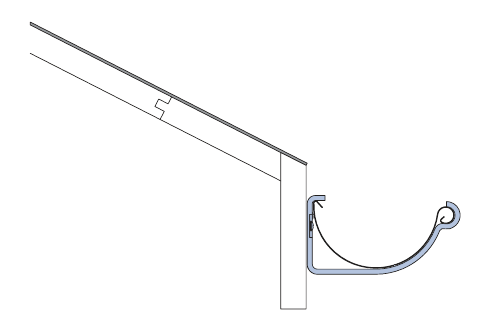
Fascia brackets fix to a fascia board or directly to the wall of a building. Vertical fascia boards are the most common in the UK, but adjustable fascia brackets are available for use on angled fascia boards.
Rafter brackets
Rafter brackets fix directly to the roof rafters. They are typically used on buildings with overhanging roof structures or particularly uneven wall surfaces. The rafter bars can be twisted to allow side fixing where access to the top of the rafter is limited.
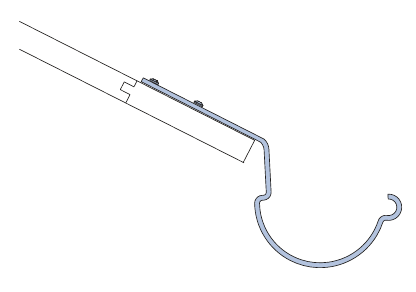
Rafter bars should be bent to the angle needed for the pitch of the roof, and a KBO bracket bender can be used for this. Rafter brackets can also be supplied twisted or bent for a charge of £2 per bracket (Lindab trade price list, July 2026).
Fascia or rafter bracket: which should you choose?
| Fascia bracket | Rafter bracket | |
|---|---|---|
| Fixes to | Fascia board or the wall | Roof rafters |
| Best for | Standard vertical fascia boards; angled boards with adjustable brackets | Overhanging roofs and uneven wall surfaces |
| Adjustment | Adjustable versions suit angled fascias | Bars can be bent to the roof pitch or twisted for side fixing |
How many gutter brackets do you need?
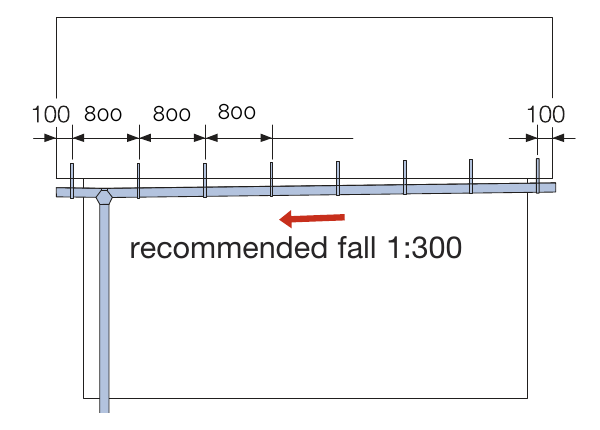
Fix brackets at 800mm centres, with the end brackets 100mm in from the roof edge. To work out how many brackets a run needs, use this formula:
For example, an 8m run needs (8 ÷ 0.8) + 1 = 11 brackets.
Gutter bracket calculator
Enter the length of your gutter run to get the number of brackets and the total fall.
- Brackets needed
- -
- Total fall (1:300)
- -
Installing brackets to the correct fall
A gutter must fall towards its outlet so rainwater drains away instead of standing in the run. Lindab recommends a fall of 1:300, which means a drop of 10mm over every 3m. A single gutter run should not be longer than 10m.
- Fix the lowest bracket firstInstall the bracket next to the outlet.
- Fix the highest bracketInstall the bracket at the opposite end of the gutter run.
- Pull a string between the twoThe string shows the level for every other bracket, so fix the rest along it at 800mm centres.
Where several downpipes sit along one gutter run, install the gutter with a high point between the pipes so that it slopes towards each outlet.
Setting the height of the highest bracket
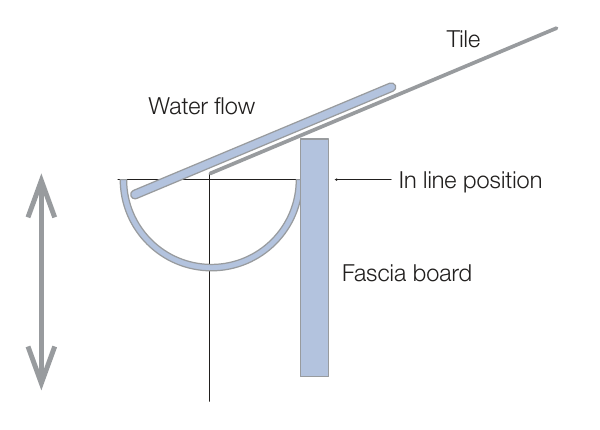
The front lip of the highest bracket should not sit higher than the position horizontally in line with the roof edge. In areas with heavy snowfall, install the highest bracket lower. Rectangular gutter follows the same principles as half round gutter.
Gutter bracket questions
How far apart should gutter brackets be?
Fix gutter brackets at 800mm centres, with the end brackets 100mm from the roof edge.
How many gutter brackets do I need for a run?
Use the formula number of brackets = (L ÷ 0.8) + 1, where L is the length of the run in metres. An 8m run needs 11 brackets.
What fall should a gutter have?
Lindab recommends a fall of 1:300, which is a drop of 10mm over every 3m, towards the outlet.
What is the longest single gutter run?
A single gutter run should not be longer than 10m.
Should I use fascia brackets or rafter brackets?
Use fascia brackets where there is a fascia board or a wall to fix to. Use rafter brackets on overhanging roofs or uneven walls, where fixing to the rafters is better.
Do rectangular gutters use the same bracket rules?
Yes. Rectangular gutter installation follows the same principles as half round gutter installation.
Ready to order brackets?
Next: see how to create a downpipe offset, read the full installation guide or browse the component guide.