
On many buildings the gutter sits away from the wall, so the downpipe has to step in to reach it. An offset does this. This guide explains how to build an offset from pipe bends, gives the pipe lengths for 70° bends, and covers fixing the downpipe brackets.
What is a downpipe offset?
The roofline, where the gutter is fitted, is commonly positioned away from the walls of the building. An offset arrangement connects the gutter outlet to the downpipe stack running down the wall.
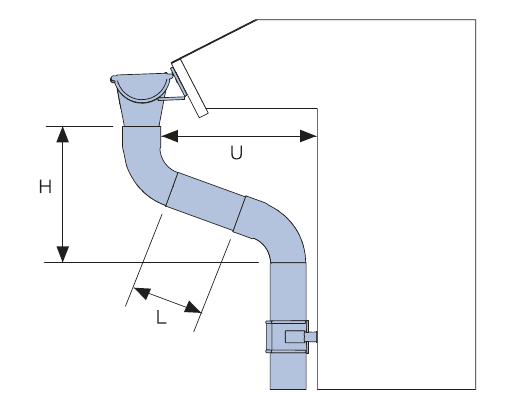
The measurement U is the projection of the offset, which is the distance from the outlet to the wall. H is the height the offset takes up, and L is the length of intermediate pipe between the two bends.
Choosing the right offset
SOKN one-piece offset
Available with a fixed projection of 100mm. Choose it where the projection is exactly 100mm.
Bends and a pipe length
For larger projections, build the offset from pipe bends and a length of SROR pipe or an MST intermediate pipe cut down to the length you need.
Bend angles
Bends at 70° are typically used to create offsets. 85°/90° bends may be preferred for very long projections, but flow capacity is reduced.
Which bends to use
- Use a BK conical bend at the top of the offset.
- If the pipe has a spigot bottom, use a BK conical bend at the bottom of the offset as well.
- If the pipe does not have a spigot bottom, use a BM or BKM pipe bend with socket at the bottom.
Offset pipe length table for 70° bends
Measure the projection U, find it in the first column, then read across for the height H and the length of intermediate pipe L. Use the table as an indication of the length of pipe needed.
| U: projection (mm) | H: height (mm) | L: intermediate pipe (mm) |
|---|---|---|
| 220 | 275 | 0 |
| 270 | 290 | 100 |
| 300 | 300 | 135 |
| 350 | 320 | 185 |
| 400 | 340 | 240 |
| 450 | 355 | 290 |
| 500 | 375 | 345 |
| 550 | 395 | 400 |
| 600 | 410 | 455 |
| 650 | 430 | 505 |
| 700 | 450 | 580 |
| 750 | 465 | 610 |
| 800 | 485 | 665 |
| 850 | 505 | 720 |
| 900 | 520 | 770 |
| 950 | 540 | 825 |
| 1000 | 555 | 880 |
| 1050 | 575 | 930 |
| 1100 | 595 | 985 |
| 1150 | 610 | 1040 |
| 1200 | 630 | 1090 |
Fixing downpipe brackets
Fix pipe brackets at 1.5m centres. Fix the highest pipe bracket 150mm from the offset, or from the hopper head at the top of the stack. Use a spirit level or plumb line to line up the other brackets.
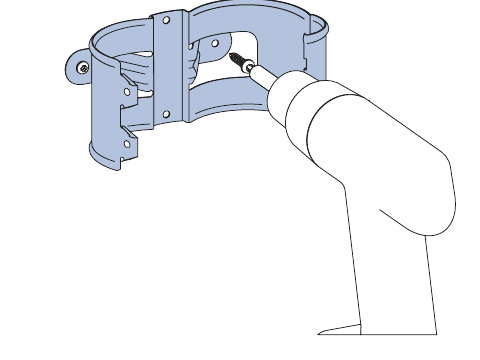
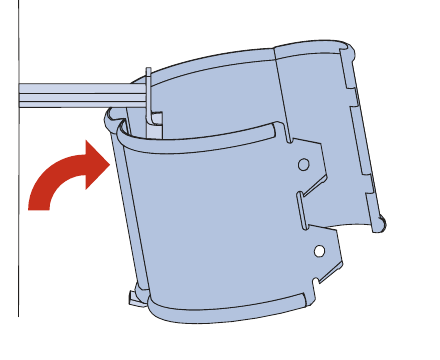
Pipe brackets are usually installed with screw-to-wall fixing or drive-in fixing. The choice depends on the construction of the building, the installer’s preference or regional convention.
- SSVU universal pipe brackets suit either fixing method and have a click lock.
- SVHA brackets are used on unpainted Rainline systems and have a wedge lock.
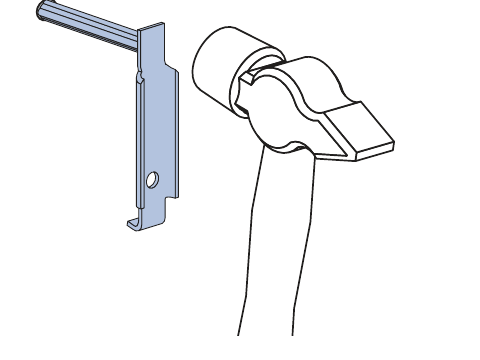
- Drive-in fixing: snip off the fixing arms so the SST drive-in spike can be used. Drive-in spikes are ordered separately.
Downpipe offset questions
What is an offset on a downpipe?
An offset steps the downpipe in from the gutter outlet to the wall. It is needed because the gutter often sits further out than the wall of the building.
What angle bends should I use to make an offset?
Bends at 70° are typically used. 85°/90° bends can suit very long projections, but flow capacity is reduced.
Is there a one-piece offset?
Yes. The SOKN one-piece offset has a fixed projection of 100mm. For larger projections, build the offset from pipe bends and a length of SROR or MST pipe cut to size.
How far apart should downpipe brackets be?
Fix pipe brackets at 1.5m centres, with the highest bracket 150mm from the offset or the hopper head at the top of the stack.
Which pipe brackets suit Rainline?
SSVU universal pipe brackets suit screw-to-wall and drive-in fixing. Unpainted Rainline systems use SVHA brackets.
Need help with an offset?
Next: learn about gutter brackets and fall, read the installation guide or browse the component guide.